Corvigor
A water integrated hemodialysis chair for fatigue management
Patient Comfort, Healthcare Product Design, Hydrotherapy
ROLE
Design Researcher, Industrial Designer
TIMEFRAME
5 months | 2025
TEAM
INDQ Product Design Studio
SKILLS
User Experience, Human Factors, Industrial Design
OVERVIEW
What if a dialysis chair was designed for comfort, not just function?
Research spanned hospital visits, patient interviews, and dialysis literature, not just chair design references.
The process moved between industrial design thinking and human factors research, refining the product through both lenses at once.
The project didn't stop at renders - it moved through form exploration, CAD, and a real manufacturing breakdown.
PROBLEM
Fatigue is the most severe complication of dialysis, and current chairs don't address it.
Existing dialysis chairs are built almost entirely around medical function and safety, with little attention to patient comfort or emotional well-being during long treatment hours. Research literature describes dialysis-related fatigue as a profound exhaustion that affects a patient's whole body, not just a passing tiredness, one that limits their ability to return to normal activities even after a session ends.
Hospital visits across multiple cities (including Jupiter Hospital, KEM Hospital, and Sahyadri Hospital in Pune, and Asian Institute of Nephrology in Vizag) and direct patient interviews confirmed this gap firsthand. One recurring patient, interviewed at length about his ideal dialysis chair, asked for basics most chairs don't offer: better posture support, integrated storage for personal items like his tablet and headphones, and simply more warmth and color in an otherwise clinical environment.
OPPORTUNITY
Comfort research already exists, dialysis chair design just hasn't caught up.
Hydrotherapy Has a Track Record
Multiple published studies point to warm-water therapy reducing fatigue and improving comfort during dialysis, an approach current chairs don't integrate at all.
Patient research made clear that dignity and trust matter as much as ergonomics. A chair that feels clinical undermines relaxation no matter how well it reclines.
The same therapeutic approach that helps dialysis patients could plausibly extend to other long-sitting therapies, like chemotherapy or infusion treatment.
Solution
After early research, the brief itself was rewritten: design a temperature-controlled, ergonomically optimized, dry-weighted water-therapy chair that bridges healthcare and wellness for hemodialysis patients, in both home and clinical settings. Beyond treatment, the chair needed to support rehabilitation, stress relief, and chronic disease management without compromising clinical safety.
FINAL ARTIFACTS

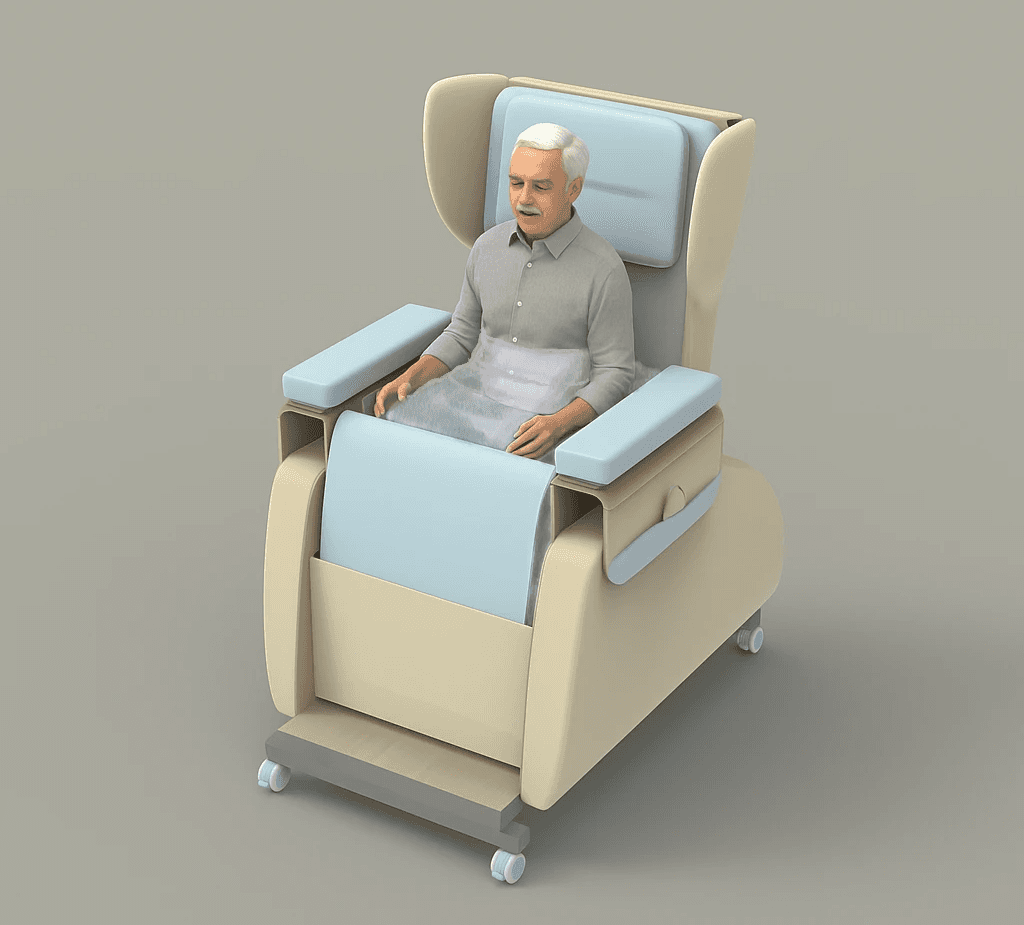
Patients get the sensory benefit of floatation and warmth without direct water contact, keeping the system leak-proof and clinically safe.

Backrest, footrest, and armrest movement adjust independently, supporting different postures across a multi-hour session.

Built-in bladder/tray systems and side-rail access keep clinical equipment and emergency access uncompromised by the comfort layer.
Key Design Moments

Two competing concepts were explored: one with the water bladder attached directly to the chair frame, and one with it detachable via a hinge door mechanism. The detached concept won out for easier maintenance and clinical access, directly addressing the safety and repairability essentials named in the redefined brief.

Multiple mockups (2.1 and 2.2) tested how a patient moves from upright to a fully reclined position without needing staff assistance for every adjustment, a direct response to the fatigue and limited mobility observed in patient research.

Dozens of form studies were sketched in parallel with form explorations tied directly to specific prototyping methods, ensuring the final form wasn't just visually resolved but buildable with the fabrication approach in mind.

Rather than stopping at CAD renders, the final design was broken into buildable subsystems, base and structural frame, internal mechanisms and electricals, enclosure panels, seating cushioning, armrest and side rails, and headrest and upholstery, each with its own material spec and fabrication process.
Research
Secondary research covered the landscape of long-sitting therapies (LSTs) beyond dialysis alone, chemotherapy, IV antibiotics, blood transfusions, and infusion therapies, comparing session duration, frequency, and patient state across each. This was paired with published case studies on seated hydrotherapy for hemodialysis, including warm-water footbath studies showing measurable improvements in fatigue and sleep quality.
Primary research meant visiting hospitals and dialysis centers directly, observing real sessions, and interviewing patients about their actual in-session and at-home experience. A patient's own "dream dialysis chair" wishlist, gathered through a participatory sketching activity, and a comfort-effort mapping exercise scoring routine dialysis tasks by ease and speed, both fed directly into the design direction that followed.
Futurescope
The current prototype has a fixed seat pan; a documented Gen 2 direction would add seat-pan tilt adjustment to support zero-gravity, Trendelenburg, and reverse-Trendelenburg postures used in clinical and surgical contexts. A modular side-rail system is also planned to allow easier patient transfer to a bed or stretcher, and to support CPR access when needed.
Longer-term, the vision extends Corvigor's modularity beyond dialysis entirely, toward other long-sitting therapies like chemotherapy and infusion treatment, positioning the chair as a home-adaptable recovery platform rather than a single-purpose clinical device. Specific directions explored include intradialytic pedaling (combining light physiotherapy with treatment time), integrated water-jet massage for circulation, and light/sound-based wellness routines for stress reduction during sessions.
What I learned
Complementing disciplines
Moving between industrial design thinking and human factors research meant every ergonomic decision got tested against both what looked and felt right, and what user testing on the first-generation prototype actually revealed about usability gaps.
Comfort research doesn't stay in one lane.
The strongest evidence for this chair's premise came from published hydrotherapy and thermotherapy studies, fields far outside typical product design reference material, showing how valuable it can be to pull research from outside your own discipline.